
What are the best AI-powered CRM solutions in the US right now?
The three platforms worth your attention in 2026 are Karrie CRM, Intrigue IT Solutions AI CRM, and QuotaBuster AI. Each takes a different angle on what "AI in CRM" actually means in practice, and the right pick depends almost entirely on what your sales process looks like today.
AI-powered CRM systems can improve sales conversions by up to 30% through personalized marketing and predictive lead scoring, and they can predict customer retention with up to 90% accuracy. Those numbers set the ceiling. Whether you hit it depends on which platform you choose and how well it fits your team.
| Platform | Key Features | AI Capabilities Included | Target User Base | Integration Options | Best For |
|---|---|---|---|---|---|
| Karrie CRM | Real-time lead scoring, automated follow-ups, sales forecasting | Lead scoring, churn prediction, pipeline forecasting | Sales teams needing live lead insights | CRM, email, marketing tools | Real-time lead insights and follow-up automation |
| Intrigue IT Solutions AI CRM | AI segmentation, outreach automation, multichannel integration | Generative content creation, AI assistants, audience segmentation | Businesses prioritizing marketing automation | ERP, marketing automation, multichannel platforms | AI-driven marketing automation and integrations |
| QuotaBuster AI | Pipeline management, AI coaching, forecasting, quota planning, deal risk analysis | Methodology-based coaching (MEDDIC, Challenger, SPIN), automated follow-up drafting, meeting insights | Quota-carrying B2B sales professionals | CRM intelligence, email, calendar, productivity tools | Integrated AI coaching and pipeline management in one dashboard |
Karrie CRM focuses tightly on the sales engagement layer. Its real-time lead scoring surfaces the hottest prospects as they engage, and its automated follow-up workflows mean reps spend less time deciding who to call next. For teams that live and die by pipeline velocity, that focus is a genuine advantage.

Intrigue IT Solutions AI CRM takes a broader marketing-plus-sales view. Its AI segmentation engine groups contacts by behavior and attributes across channels, and its generative content tools can draft outreach at scale. If your biggest bottleneck is getting the right message to the right segment fast, this platform addresses that directly.
QuotaBuster AI is built for the individual quota carrier who needs everything in one place. Pipeline management, AI coaching tied to methodologies like MEDDIC and Challenger, deal risk flags, revenue forecasting, and automated follow-up drafting all live in a single dashboard. It is the only platform in this group that functions as a personal AI sales coach rather than a team-level CRM layer.
Key buyer decision factors:
- Does the platform include AI features in the base plan, or are they locked behind premium tiers?
- How quickly can a rep get value without a lengthy implementation?
- Does the AI coaching align with the sales methodology your team already uses?
- Can it connect to the tools you already run, such as your email client, calendar, or ERP?
What core features and benefits do AI-powered CRM platforms actually deliver?
The key AI features that move the needle in real sales workflows are real-time lead scoring, automated email drafting, meeting summaries, and 24/7 AI chatbot support. These are not novelties. They directly cut the time reps spend on tasks that do not require human judgment.
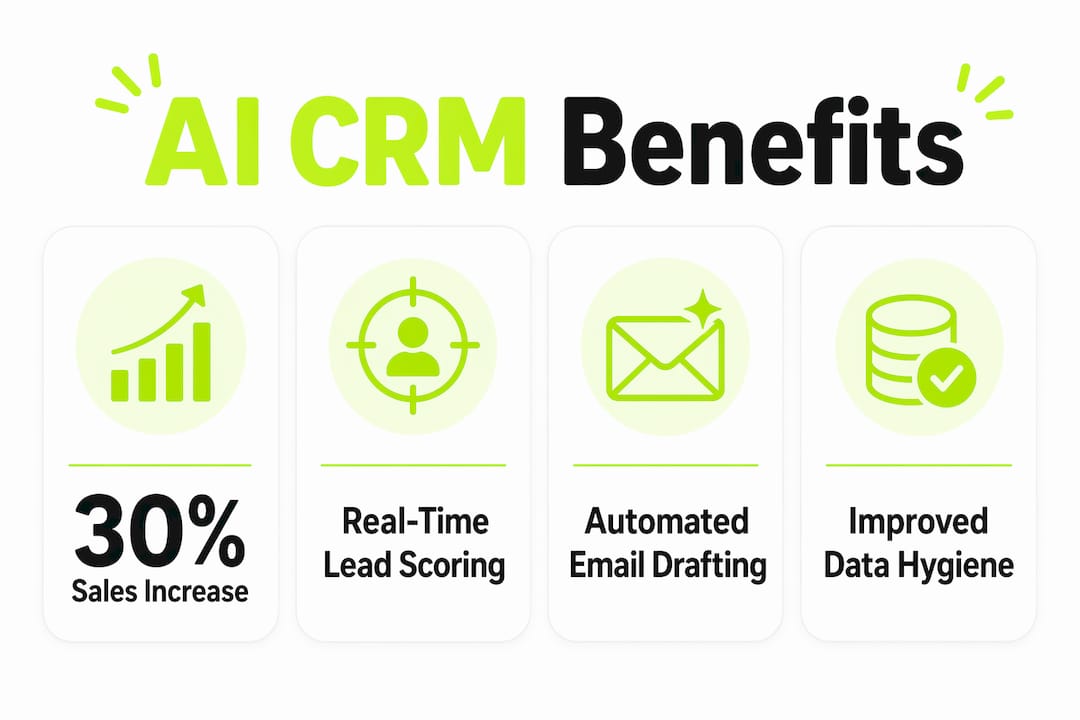
Predictive analytics is where AI CRM earns its keep most visibly. The system analyzes historical deal data, engagement signals, and customer behavior to forecast which leads will convert and which accounts are at risk of churning. Sales managers get a cleaner pipeline view; reps get a prioritized call list instead of a flat spreadsheet.
Core AI features to expect from a mature platform:
- Real-time lead scoring based on engagement, company size, and interaction history
- Automated follow-up drafting and outreach sequencing
- Predictive sales forecasting using historical pipeline data
- AI-generated meeting summaries and next-step recommendations
- Customer churn prediction to flag at-risk accounts before they go quiet
- Sentiment analysis across email and call transcripts
- 24/7 chatbot support for inbound customer inquiries
The benefits compound quickly once these features are running. Reps focus on high-probability deals instead of guessing. Marketing sends personalized content to the right segments automatically. Customer service resolves tickets faster because the AI routes them to the right agent based on intent and language. The AI customization, unified customer view, predictive analytics, and ease of adoption are the four dimensions that separate platforms that deliver from those that disappoint.
One underappreciated benefit is data hygiene. AI CRM tools automate data entry, deduplication, and enrichment, which means the underlying customer records stay accurate without manual cleanup. Clean data makes every other AI feature more reliable.
How do you choose the right AI-powered CRM for your business?
Start with your current stack, not the vendor's feature list. The most important selection factors are integration with tools you already use, customization options, pricing transparency, and how easy the platform is to adopt without a six-month implementation project.
Ask these questions before signing anything:
- Which AI features are included in the plan you can actually afford, and which require an upgrade?
- Does the platform integrate with your existing ERP, marketing automation tools, or email client without custom development?
- Can you customize the AI models or workflows to match your specific sales process?
- What does onboarding look like, and does the vendor provide hands-on training or just documentation?
- Is there a pilot or trial option so you can test real-world performance before committing?
Pricing transparency matters more than most buyers realize. AI features are frequently reserved for top-tier licensing plans, so a platform that looks affordable at the entry level may not deliver the capabilities you evaluated during the demo. Always confirm which AI features are active at your intended price point.
Onboarding is the step most teams underestimate. A platform with a steep learning curve will see low adoption regardless of how good the AI is. Prioritize vendors that offer structured onboarding, role-specific training, and a clear path from day one to full deployment.
Pro Tip: Before evaluating any platform, map your current sales workflow step by step and identify the three tasks that consume the most rep time. Use that list as your evaluation rubric. A platform that automates those three tasks specifically will deliver more value than one with a longer feature list that does not address your actual bottlenecks.
Selection criteria checklist:
- AI features included at your price tier (not just listed on the marketing page)
- Native integrations with your existing tools (ERP, email, calendar, marketing automation)
- Customization depth for workflows and AI models
- Onboarding support and training resources
- Security, compliance, and data governance controls
- Trial or pilot availability before full commitment
- Vendor track record with teams at your company size and industry
What do experts say about adopting AI-powered CRM strategically?
Research positions AI CRM as a strategic dynamic capability, not just a collection of automation tools. The organizations that get the most out of it treat it as a framework that integrates data management, multichannel communication, and tailored service delivery across the business. That framing changes how you plan the rollout.
The practical implication: do not deploy AI CRM feature by feature in isolation. The competitive advantage comes from the combination of clean data, connected channels, and AI that can act across all of them. A lead scoring model that cannot see your email engagement data is working with one hand tied behind its back.
Human-in-the-loop workflows remain the industry standard for high-stakes B2B sales. Approval gates and guardrails on AI-generated outreach reduce the risk of an autonomous agent sending something that damages a relationship or misrepresents your offer. In complex enterprise deals, the AI should surface the recommendation and the rep should pull the trigger.
AI-overload is a real adoption risk. Platforms that layer in too many AI features at once overwhelm users and drive down adoption. The teams that succeed tend to activate a small number of high-impact features first, measure the results, and expand from there. Complexity added faster than the team can absorb it produces digital fatigue, not productivity.
Strategic benefits of AI CRM done right:
- Unified customer data that feeds every AI model across the platform
- Multichannel integration so AI sees the full customer picture, not just one channel
- Predictive insights that let managers coach reps on specific deals, not just overall numbers
- Automated routine tasks that free senior reps for relationship-intensive work
- Scalable personalization across large prospect lists without proportional headcount growth
Expert guidance consistently points to experienced consultants for the planning phase, particularly for mid-market and enterprise deployments where data migration, compliance requirements, and change management add complexity. The technology is only part of the equation.
Quotabuster AI gives quota-carrying reps everything in one place
If you carry a quota and you are tired of toggling between five different tools to manage your pipeline, prep for calls, and draft follow-ups, Quotabuster is built for exactly that problem.
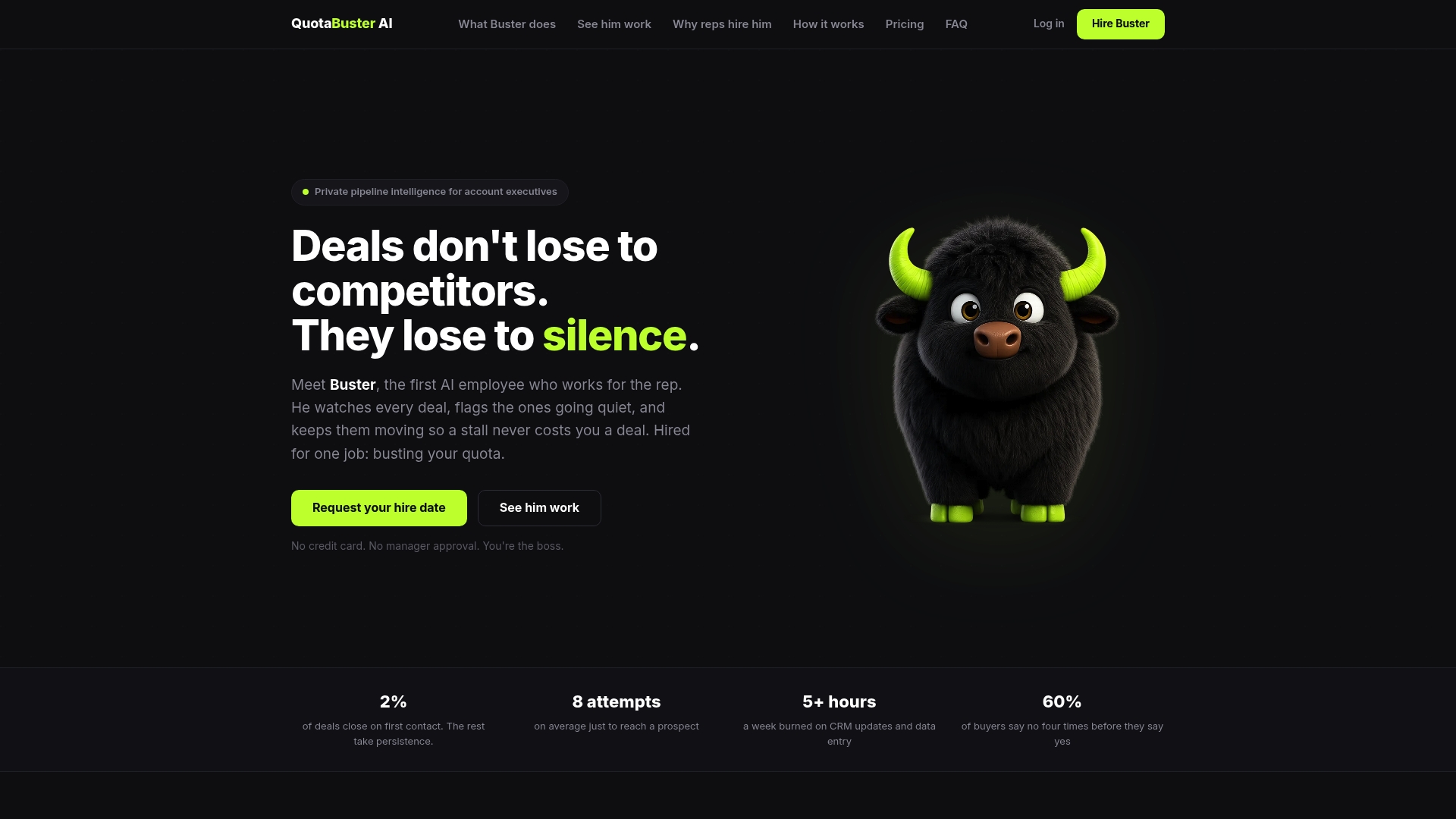
Quotabuster AI combines pipeline management, AI coaching, revenue forecasting, quota planning, deal risk analysis, email and meeting insights, and account research in a single dashboard. The AI coaching layer supports MEDDIC, Challenger, and SPIN, so it works with the methodology your team already uses rather than forcing a new one. Automated follow-up drafting means reps spend less time staring at a blank email and more time on calls that close. For B2B sales professionals who want the productivity of a full sales stack without the cost and complexity of managing multiple subscriptions, Quotabuster is the direct answer.
Key Takeaways
AI-powered CRM platforms deliver the highest return when AI features are included in the base plan, integrated across the full sales workflow, and adopted with human oversight in place for high-stakes decisions.
| Point | Details |
|---|---|
| Conversion and retention lift | AI-driven CRMs can improve sales conversions and predict customer retention with high accuracy. |
| Feature depth varies by tier | AI capabilities are often locked behind premium plans; confirm which features are active at your actual price point before committing. |
| Human oversight stays critical | Human-in-the-loop guardrails reduce errors in complex B2B sales and protect brand integrity in automated outreach. |
| Avoid AI-overload on rollout | Activating too many AI features at once drives digital fatigue; start with the highest-impact features and expand after measuring results. |
| Quotabuster for quota carriers | Quotabuster AI consolidates pipeline management, AI coaching, forecasting, and follow-up automation in one dashboard for B2B sales professionals. |